
₹905.00 – ₹68,960.00Price range: ₹905.00 through ₹68,960.00
The principle of CLED Agar is based on a combination of lactose fermentation, pH indication, and electrolyte deficiency:
This combination of properties allows for simultaneous growth, differentiation, and enumeration of urinary microorganisms.
100 g Bottle (makes ~1.5–2 liters of medium)
500 g Lab Pack
1 kg Bulk Pack
(Custom sizes available depending on supplier.)
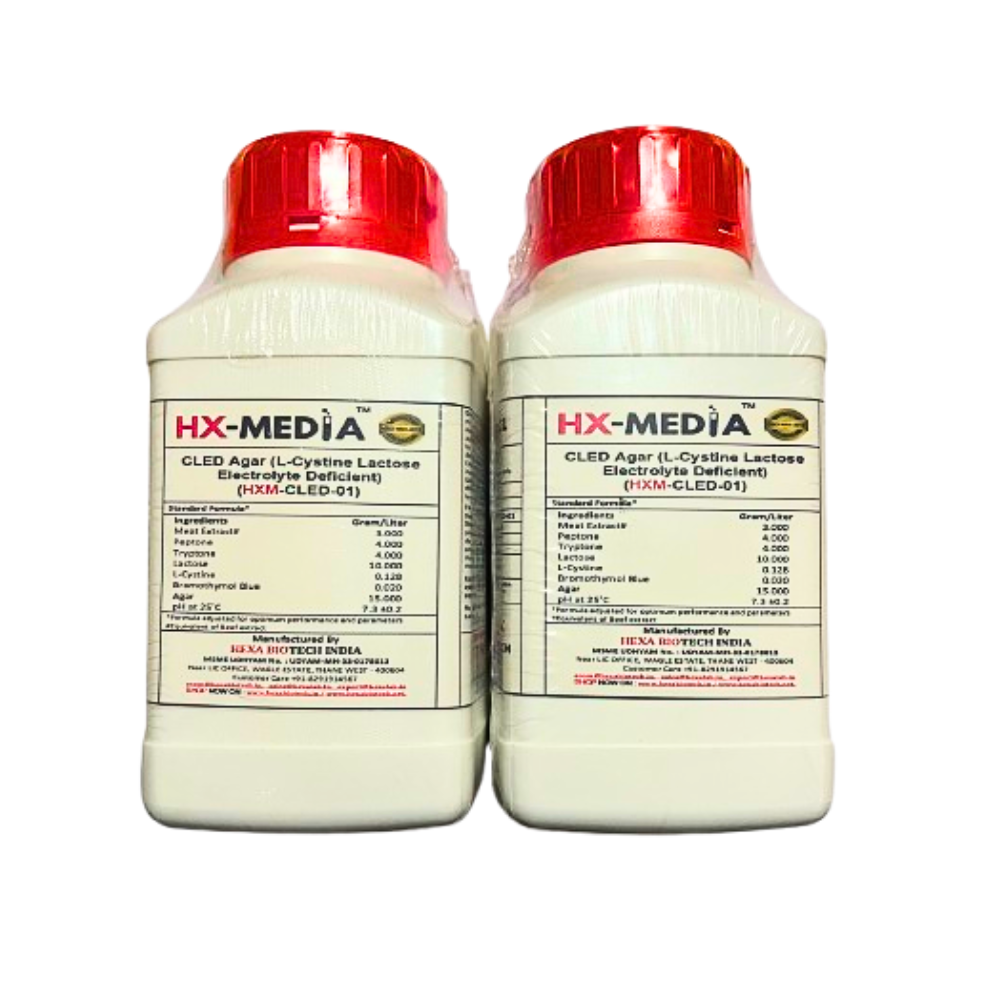
Cysteine Lactose Electrolyte Deficient (CLED Agar) is a non-selective yet differential culture medium specifically formulated for the isolation, enumeration, and differentiation of microorganisms associated with urinary tract infections (UTIs). It is extensively used in clinical microbiology laboratories for routine urine culture analysis.
CLED Agar supports the growth of a wide spectrum of Gram-positive and Gram-negative bacteria, including common urinary pathogens such as Escherichia coli, Klebsiella spp., Proteus spp., Enterococcus spp., Staphylococcus spp., and other coliform organisms.
A defining characteristic of CLED Agar is its electrolyte-deficient formulation, which effectively prevents the swarming phenomenon of Proteus species. This ensures the development of well-isolated, discrete colonies, which is critical for accurate colony counting and identification in urine cultures.
CLED Agar contains lactose as a fermentable carbohydrate and bromothymol blue as a pH indicator, enabling differentiation of organisms based on their ability to ferment lactose. Acid production from lactose fermentation results in a color change of the medium from green to yellow, allowing clear visual distinction between lactose fermenters and non-fermenters.
Additionally, the presence of L-cystine enhances the growth of cystine-dependent organisms, ensuring optimal recovery of clinically significant bacteria. The medium’s balanced nutrient composition supports robust microbial growth while maintaining clarity for easy interpretation.
CLED Agar is particularly suitable for quantitative urine culture techniques, where bacterial counts are essential for diagnosis. It provides reliable, reproducible, and easy-to-interpret results within 18–24 hours of incubation, making it a preferred choice in diagnostic laboratories.
Peptones : 4.0
Lactose : 10.0
L-Cysteine : 0.128
Bromothymol blue : 0.02
Agar : 15.0
Electrolyte-deficient base : prevents Proteus swarming
Final pH : 7.3 ± 0.2 at 25°C
✔ Routine urine culture screening
✔ Clinical microbiology and diagnostic labs
✔ Differentiation of common UTI pathogens
✔ Samples where Proteus overgrowth is a concern
| Weight | N/A |
|---|---|
| Dimensions | N/A |
| Size | 100G, 10KG, 1Kg, 500G, 5KG |
₹904.00 – ₹65,120.00Price range: ₹904.00 through ₹65,120.00

₹670.00 – ₹45,920.00Price range: ₹670.00 through ₹45,920.00

₹955.00 – ₹76,640.00Price range: ₹955.00 through ₹76,640.00

₹650.00 – ₹45,920.00Price range: ₹650.00 through ₹45,920.00


Reviews
There are no reviews yet.