Product Description
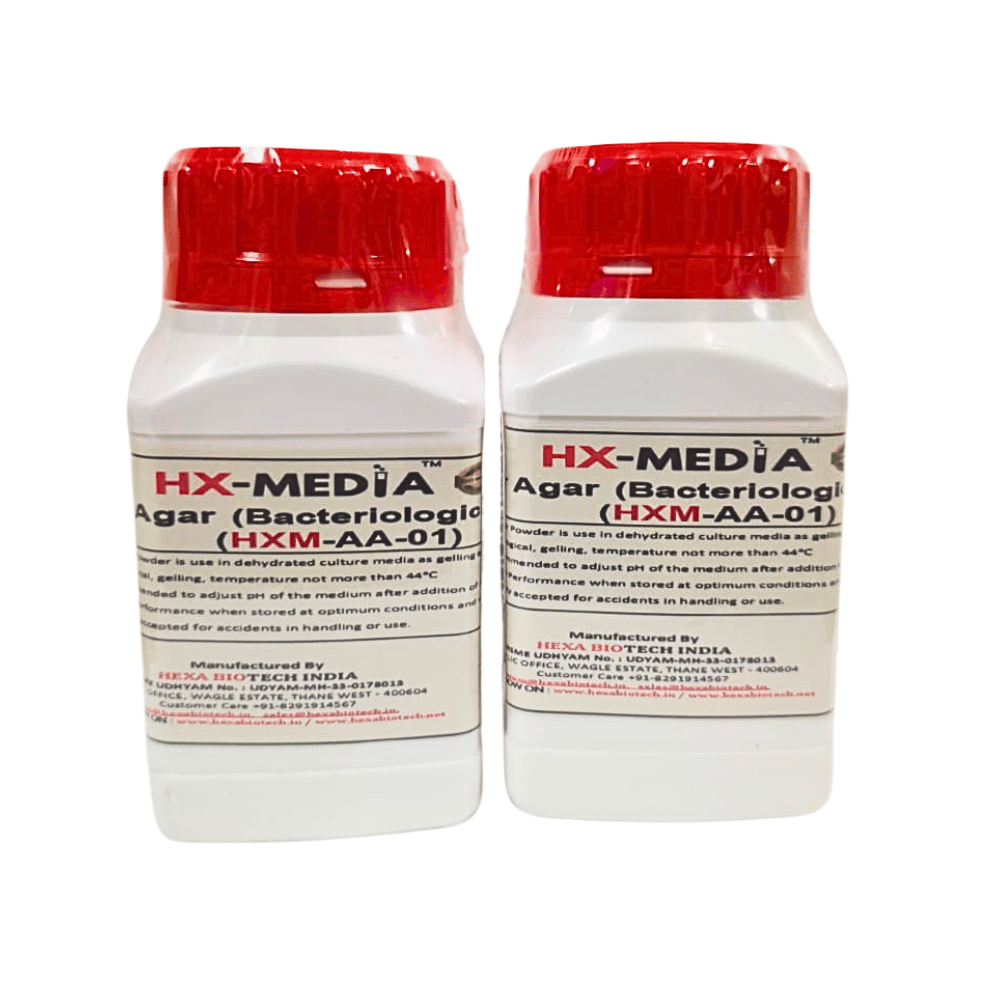
Agar Agar Powder Bacteriological Grade I – HX-Media
Product Overview
Agar Agar Powder is a natural, high-molecular-weight hydrocolloid extracted from carefully selected species of marine red algae (Rhodophyceae), predominantly Gelidium and Gracilaria. It is composed mainly of agarose and agaropectin, two polysaccharide fractions that together provide its unique gel-forming and stabilizing properties. Due to its high purity, consistency, and inert behavior, agar is widely regarded as a standard solidifying agent across microbiological, biotechnological, food, and pharmaceutical industries.
In microbiological applications, Agar Agar Powder plays a critical functional role as a non-nutritive solidifying medium. Unlike other gelling agents, agar powder is not utilized or degraded by most microorganisms, which ensures that microbial growth and metabolism depend entirely on the nutrients incorporated in the culture medium. This property is essential for accurate microbial isolation, enumeration, and identification, as it prevents interference with biochemical reactions or colony development.
From a physicochemical perspective, agar exhibits a distinctive property known as thermal hysteresis, where the melting temperature (~85–95°C) is significantly higher than the gelling temperature (~32–40°C). This allows media to remain liquid during sterilization and handling, yet rapidly form a firm, stable gel upon cooling. The gel formed is a three-dimensional hydrogen-bonded network capable of holding large amounts of water, creating a moist, porous environment ideal for microbial growth and nutrient diffusion.
Agar gels are characterized by their high gel strength, elasticity, and clarity, enabling clear visualization of colony morphology, pigmentation, hemolytic reactions, and differential indicators. High-quality agar contains minimal impurities such as sulfates, heavy metals, and organic residues, ensuring optimal growth conditions and reproducibility in laboratory testing. Additionally, its low electroendosmosis (EEO) supports accurate diffusion of antibiotics and other compounds, making it suitable for sensitivity testing and analytical procedures.
The product typically appears as a cream to light beige free-flowing powder, which disperses in water and dissolves completely upon heating. It forms clear to slightly opalescent gels, depending on purity and concentration. Agar Agar Powder can produce firm gels at relatively low concentrations (1.5–2.0% w/v), making it both efficient and economical for large-scale use.
Beyond microbiology, Agar Agar Powder is widely utilized in:
- Food industry as a vegetarian gelling agent and stabilizer
- Pharmaceutical formulations for controlled-release systems and suspensions
- Plant tissue culture as a support matrix for explant growth
- Biotechnology and molecular biology (in purified forms like agarose)
Its biodegradable, plant-derived, and non-toxic nature makes it an environmentally friendly alternative to synthetic gelling agents.
Overall, Agar Agar Powder is a versatile and indispensable material, offering a combination of structural stability, biological inertness, clarity, and reproducibility. These characteristics make it a cornerstone product in microbiological media preparation and a wide range of industrial applications, ensuring reliable and consistent performance across laboratories and production environments.
🔬 Key Features
- High gel strength: Produces firm, stable gels
- Excellent clarity: Enables easy observation of colonies
- Low impurity level: Minimal interference in microbial growth
- Thermal stability: Remains solid at incubation temperatures
- Non-toxic and inert: Does not inhibit microbial activity
- Consistent batch quality: Reliable and reproducible results
- Efficient usage: Effective at low concentrations
🎯 Applications
- Preparation of solid microbiological media (nutrient agar, MacConkey agar powder, etc.)
- Isolation and enumeration of microorganisms
- Clinical diagnostics for pathogen identification
- Food and beverage microbiology for contamination testing
- Pharmaceutical quality control and sterility testing
- Water and environmental analysis
- Research and academic laboratories
🧪 Composition (Typical)
- Agar (from red algae) – 100%
Major components include:
- Agarose (gel-forming fraction)
- Agaropectin (non-gelling fraction contributing to texture)
🛠️ How to Use
- Accurately weigh agar (typically 15–20 g per liter)
- Suspend in distilled water or prepared medium base
- Heat with agitation until completely dissolved (clear solution)
- Sterilize by autoclaving at 121°C for 15 minutes
- Cool to 45–50°C before pouring into Petri plates or tubes
- Allow to solidify under sterile conditions
⏳Storage and Shelf Life
- Store in a cool, dry, and well-ventilated area (10–30°C)
- Keep container tightly closed to prevent moisture absorption
- Protect from humidity, direct sunlight, and contamination
- Typically 3–5 years in dehydrated form when properly stored
- Performance should be verified if stored beyond recommended conditions
👍 Ideal For
✔ Microbiological media preparation in research and diagnostic laboratories.
✔ Food, water, and environmental microbiology testing.
✔ Academic teaching labs requiring reliable culture media components.
✔ Applications needing high-clarity, consistent-strength gel bases.




Reviews
There are no reviews yet.