
₹24,950.00 – ₹37,500.00Price range: ₹24,950.00 through ₹37,500.00
Here’s a concise technical description for Chromasol JADE C18 (USP L1) :
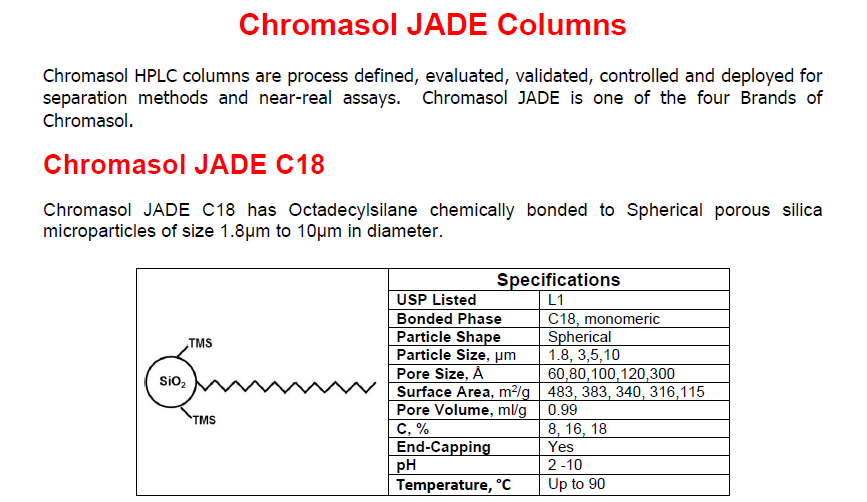
Type: Reversed-phase HPLC column (C18, octadecylsilane, end-capped)
Particle Size: 5 µm
Pore Size: 100–120 Å
Surface Area: ~400 m²/g
Carbon Loading: ~16%
pH Stability: 2–10
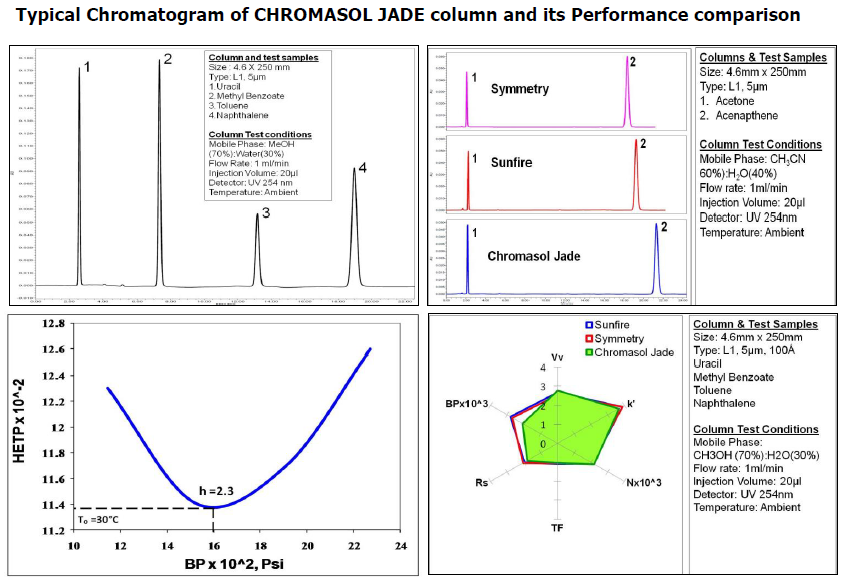
Efficiency: Reduced plate height ~2.3, low tailing factor
Applications: Small molecule analysis, pharmaceuticals, stability studies
Special Features: Robust, reproducible packing; good retention and selectivity; compatible with acid/base cleaning; analytical to prep scale options
It’s a robust, high-performance general-purpose C18 column suitable for pharmaceutical and small-molecule HPLC analysis.
Here are more technical details, pulled together from Intek Chromasol’s own documentation, plus interpretation:
Stationary Phase / Base Material
The base material is porous spherical silica.
The bonded phase is octadecyl (C18) silane.
The carbon loading is approximately 16%.
The silica is end-capped, which means residual silanol groups are capped, improving peak shape (especially for polar / basic analytes).
Particle Size & Pore Size Options
According to Intek, for the analytical JADE C18, the particle size is 5 µm.
Pore sizes available: 100 Å and 120 Å for the analytical Jade version.
Surface area: about 400 m²/g (for these pore sizes) as per Intek.
Efficiency & Column Performance
The reduced plate height (h) is ~2.3 (range 2.2–2.5), indicating good packing and column efficiency.
Theoretical plate count (N) reproducibility: % RSD ≈ 3.2%.
Peak shape (tailing factor, TF): % RSD ~1.3, which means the column gives nice, symmetrical peaks in many typical separations.
Selectivity / Retention
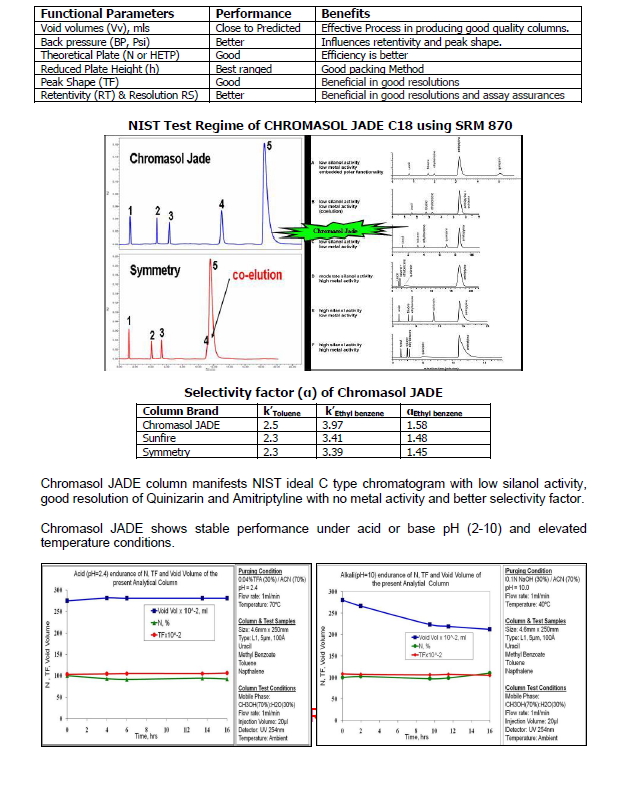
In a test using NIST SRM 870 (standard compound mix), the column showed a “five finger pattern” → this indicates good resolution for standard test compounds, and suggests low silanol or metal activity.
Selectivity factor (α) example: for toluene vs ethyl benzene, α ≈ 1.58 for Chromasol JADE (higher than some competitors in their test).
Retentivity: Intek claims higher retentivity, meaning good hydrophobic interaction, which helps for separating low molar mass compounds.
Chemical / pH Stability
The column is stable over a wide pH range: pH 2 – 10.
Acid purge test: At pH = 2, 70 °C for 16 hours → after this, only a small (2–3%) increase in void volume and TF, and ~9% increase in plate number.
Base purge test: At pH = 10, 40 °C for 16 hours → they saw a ~3% drop in plate number in the first ~9.5 h, then a ~13% increase up to 16 h; tailing factor decreases by ~2.7%, and void volume decreases by ~24%.
Interpretation: very robust column, capable of being cleaned / regenerated with acid or base, which is useful for demanding or dirty sample matrices.
Thermal Stability
While Intek doesn’t specify a maximum operating temperature explicitly in all places, the acid stability test was conducted at 70 °C, which suggests the column can handle elevated temperatures reasonably well.
For safe long-term use, especially at very high temperature, verify with Intek for your specific column dimension / variant.
Reproducibility & Quality Control
Intek emphasizes process-defined, measured, validated, controlled packing, meaning they have good quality control for batch-to-batch consistency.
They provide a validation report with the column. This typically contains key parameters: plate count, tailing factor, void volume, reproducibility.
Applications
Intek highlights use in low molar mass sample analysis.
They specifically mention pharmaceuticals — injectables, tablets, etc. — as typical application areas.
The ability to survive pH 2–10 purges makes this useful for stability studies, method development, and cleaning protocols.
Preparative / Scale-Up Variants
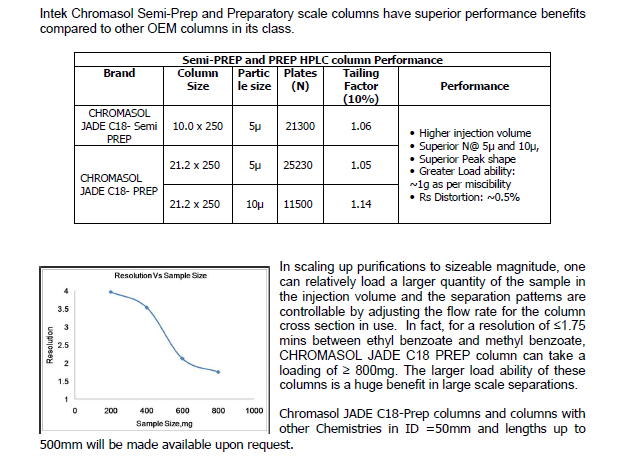
Intek also offers JADE PREP version of the C18 (same chemistry, but for preparative-scale separations).
For prep columns: listed part-numbers include IC185120-4625 for 4.6 × 250 mm, 5 µm, 120 Å prep column.
This means there is good continuity between analytical and prep scale, useful if you want to scale up a method developed on analytical scale.
Wide-Pore Variant (“WP”)
Intek has a JADE WP (wide-pore) version: pore size = 300 Å, particle size = 5 µm.
Surface area for WP: ~116 m²/g.
Carbon loading for WP: ~7.7%.
This WP version is more suited for large biomolecules (proteins, peptides) or very hydrophobic large compounds.
Robustness + Longevity: Because of its pH stability, you can do regular acid or base cleaning, potentially increasing the column’s life.
Good Efficiency: The low reduced plate height (~2.3) means good separation power without needing very small particles (which would increase back-pressure).
Flexible Applications: Useful for pharmaceuticals, but also for other small molecule separations; less optimal for very large biomolecules unless you pick the wide-pore variant.
Scale-Up Friendly: Since there is a preparative version, your method has a path to scale from analytical to prep.
Quality Control: With validation report + controlled packing, you can rely on reproducibility between batches.
| Weight | N/A |
|---|---|
| Dimensions | N/A |
| Part Number | IC185120-30125, IC185120-4610, IC185100-40125, IC185120-4615, IC185120-4025, IC185120-4625, IC185100-4625, IC85100-4615 |

₹23,995.00 – ₹25,495.00Price range: ₹23,995.00 through ₹25,495.00
₹25,500.00 – ₹29,950.00Price range: ₹25,500.00 through ₹29,950.00

Reviews
There are no reviews yet.