
₹650.00 – ₹45,920.00Price range: ₹650.00 through ₹45,920.00
The medium is based on the ability of coliform bacteria to ferment lactose, producing acid and gas under incubation:
This makes the medium suitable for preliminary screening, followed by confirmatory tests.
100 g Bottle (makes ~1.5–2 liters of medium)
500 g Lab Pack
1 kg Bulk Pack
(Custom sizes available depending on supplier.)
Lactose Broth Base is a widely used general-purpose enrichment medium designed for the presumptive detection of coliform bacteria, particularly in water, food, dairy, environmental, and pharmaceutical samples. It serves as the primary medium in microbiological quality testing, especially in the Most Probable Number (MPN) method, where it helps in estimating bacterial load through serial dilution techniques.
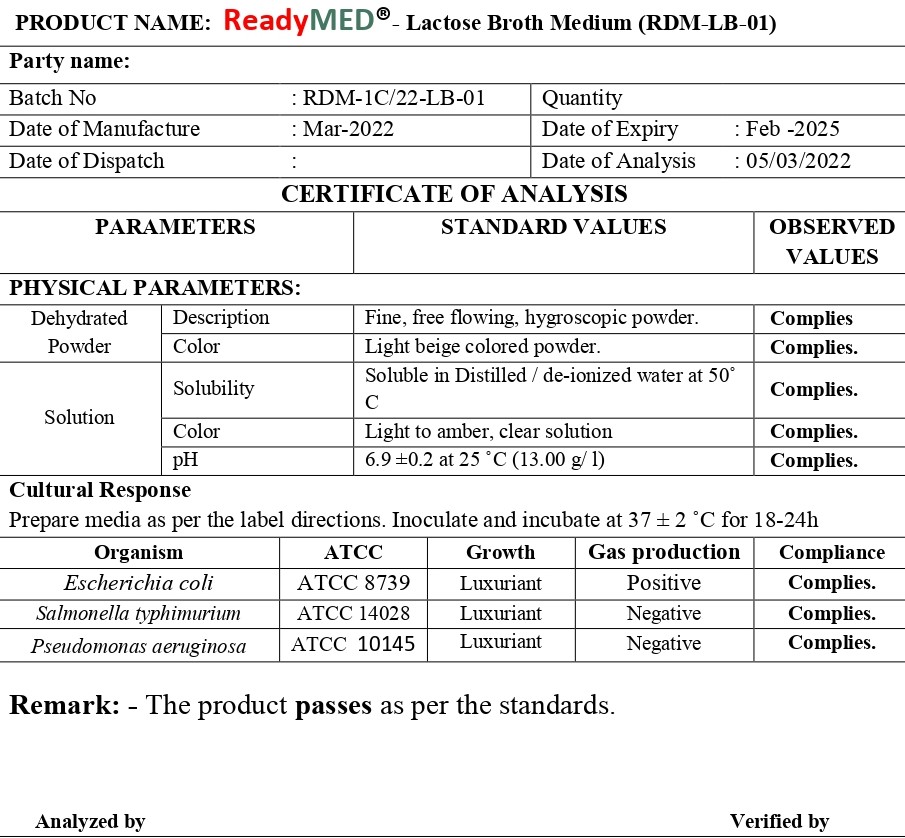
This medium is formulated with a balanced combination of nutrients and a fermentable carbohydrate (lactose), allowing the growth of non-fastidious microorganisms, including Gram-negative enteric bacteria. Lactose Broth Base it is especially effective for promoting the growth of lactose-fermenting coliforms, such as Escherichia coli, which are key indicators of fecal contamination and sanitary quality.
The presence of peptone and beef extract ensures that microorganisms receive essential nitrogen sources, vitamins, amino acids, and minerals, supporting rapid and visible growth. Lactose Broth Base acts as the differential substrate, enabling identification of organisms capable of fermenting it. When inoculated and incubated under suitable conditions, coliform bacteria metabolize lactose to produce acid and gas, which forms the basis for detection.
Lactose Broth Base is considered non-selective, meaning it does not inhibit competing flora. This characteristic makes it highly suitable for pre-enrichment and recovery of stressed or injured microorganisms, which might not grow in selective media. However, due to this non-selectivity, confirmatory testing using selective media (such as EMB agar or MacConkey media) is essential to accurately identify coliform organisms.
Lactose Broth Base is typically used with Durham tubes, which capture gas produced during fermentation, providing a clear visual indicator of a positive presumptive test. This simple yet reliable detection mechanism makes it a standard choice in routine microbiological laboratories worldwide.
In industrial and regulatory settings, Lactose Broth Base plays a critical role in:
Its ease of preparation, reproducibility, and compatibility with standard testing protocols make it a dependable and cost-effective solution for microbiological analysis.
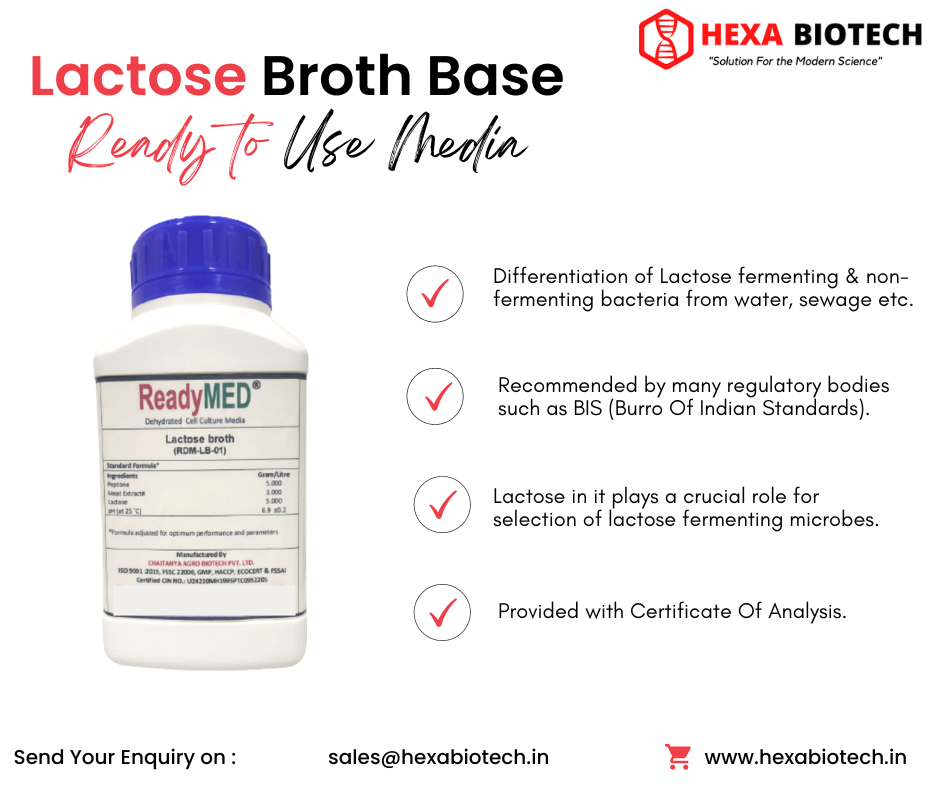
Peptone: 5.0 g
Beef Extract: 3.0 g
Lactose: 5.0 g
Final pH (25°C): 6.9 ± 0.2
✔ Water and food testing labs.
✔ MPN-based coliform detection.
✔ Recovery of stressed or injured coliforms.
| Weight | N/A |
|---|---|
| Dimensions | N/A |
| Size | 100G, 10KG, 1Kg, 500G, 5KG |

₹905.00 – ₹68,960.00Price range: ₹905.00 through ₹68,960.00

₹780.00 – ₹65,120.00Price range: ₹780.00 through ₹65,120.00

₹730.00 – ₹53,620.00Price range: ₹730.00 through ₹53,620.00

₹820.00 – ₹57,440.00Price range: ₹820.00 through ₹57,440.00

Reviews
There are no reviews yet.